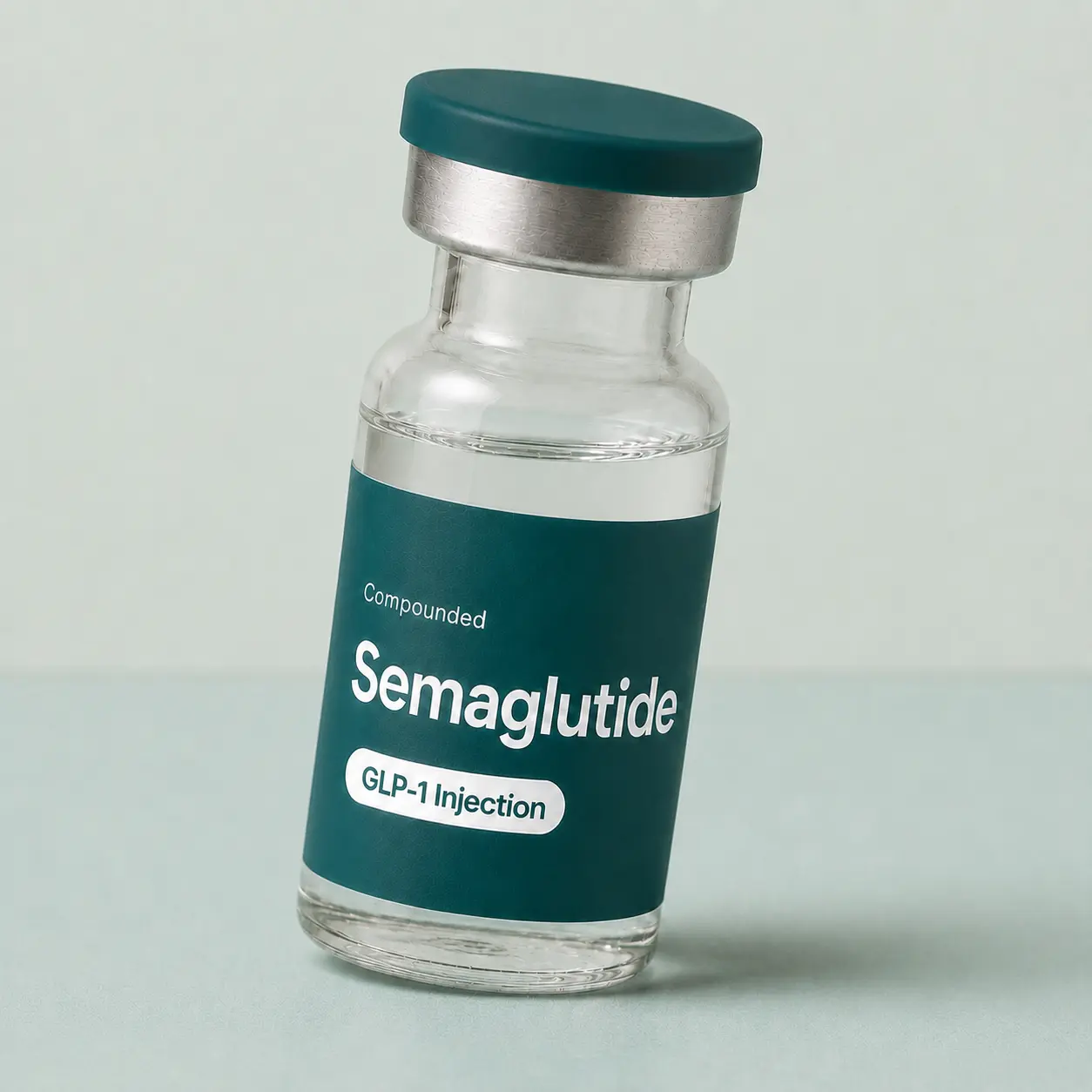
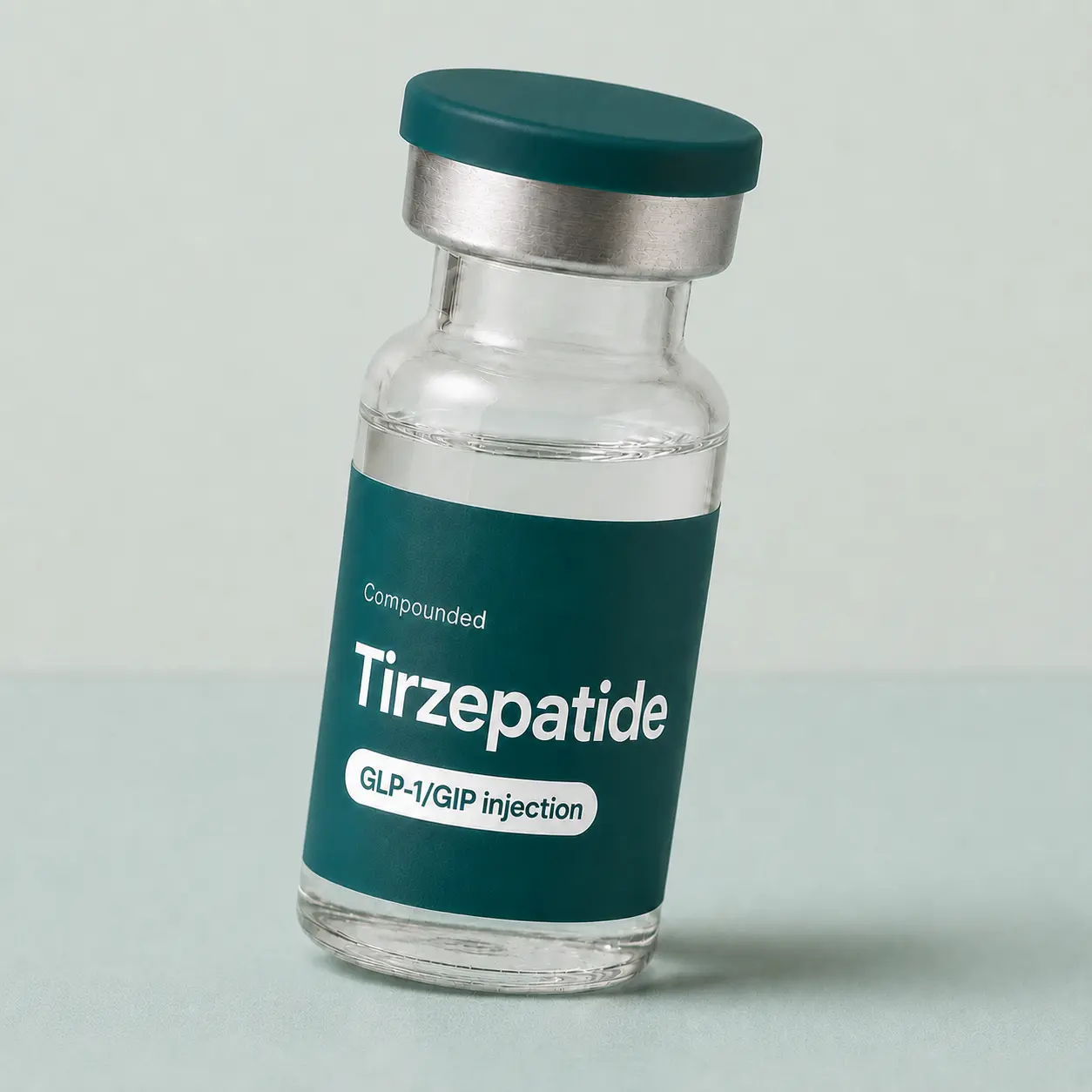
Semaglutide and tirzepatide produce 14.9% to 20.9% mean weight loss in their pivotal trials. The same appetite shutdown that makes them work also pulls protein intake down with everything else — and some of what comes off is muscle. Our position, stated up front: that is not a reason to skip the drug. It is a reason to treat two cheap countermeasures — a daily protein floor and two short resistance sessions a week — as part of the prescription from injection one, not as a rescue plan after a bad scan.
How much comes off — and what it’s made of
In STEP 1 (Wilding et al., NEJM 2021), 1,961 adults with obesity and no diabetes took semaglutide 2.4 mg weekly or placebo. At week 68, mean weight change was −14.9% versus −2.4%. In SURMOUNT-1 (Jastreboff et al., NEJM 2022), 2,539 adults were randomized to tirzepatide or placebo for 72 weeks: −15.0% at 5 mg, −19.5% at 10 mg, −20.9% at 15 mg, against −3.1% on placebo. For someone starting at 250 lbs, the top tirzepatide result works out to about 52 lbs — a trial average, not a personal prediction.
The scale hides the composition. Losing weight costs some lean tissue no matter how you do it — that part is physiology, not scandal. But DXA substudies of the GLP-1 trials (the scans that split fat mass from lean mass) put a meaningful fraction of the loss in the lean column. How large a fraction? The substudies are small next to their parent trials, and they give a range, not one clean number. Two things follow. First: nothing in the drug’s mechanism preferentially protects muscle. Second: the ratio responds to inputs you control.
Why protein is the first casualty
The mechanism is settled. GLP-1 receptor agonists slow gastric emptying and act on appetite circuits in the hypothalamus and hindbrain; they also improve insulin secretion. Tirzepatide adds agonism at the GIP receptor. What you feel: food sits longer, hunger drops, and meals shrink.
The problem is arithmetic, not pharmacology. Muscle is maintained by two inputs — mechanical load and amino acid supply. The drug removes appetite indiscriminately, so when total intake falls, protein falls with it unless you defend it on purpose. Nobody craves chicken breast at 2.4 mg.
Your hardest weeks are scheduled in advance
In STEP 1, nausea was the most common side effect, and it clustered during dose escalation. That is not bad luck — nausea follows directly from delayed gastric emptying, which is why it tracks each dose step and fades when titration slows. Standard semaglutide titration starts at 0.25 mg weekly and steps roughly every 4 weeks: 0.25 → 0.5 → 1.0 → 1.7 → 2.4 mg. On the fastest schedule that puts you at full dose around week 16; side effects stretch the timeline, and they are supposed to.
Read that schedule as a training calendar. Your worst protein weeks are the ones right after each step-up, and you know their dates in advance. Mix shakes before those weeks, not during them. Keep Greek yogurt, jerky, or whey within arm’s reach. Smaller servings, more often. Our quick high-protein meals list exists for exactly these weeks — every entry hits at least 22 g without requiring an appetite.
This is also where clinician review earns its keep. At Zappy, a US-licensed clinician reviews every case and adjusts titration — holding a dose an extra month while your protein intake recovers is a better trade than racing to 2.4 mg underfed. Zappy is cash-pay, no insurance required, FSA/HSA eligible; the compounded semaglutide and tirzepatide are prepared by LegitScript-verified 503A US pharmacies. Compounded preparations are not FDA-approved.
The protein floor: 1.2 to 1.6 grams per kilogram
The range clinicians commonly target during GLP-1 treatment is 1.2–1.6 g of protein per kilogram of body weight per day. At 176 lbs (80 kg), that is 96–128 g. At 220 lbs (100 kg), 120–160 g. Split it across three or four feedings — 120 g is four servings of 30 g, which is roughly one Greek yogurt bowl, one shake, and two palm-sized portions of meat or fish. On a low-appetite day, the shake is not optional.
That range is consensus practice: the physiological rationale is strong, but no randomized comparison crowned it. The arithmetic also gets steep at higher body weights — 1.6 g/kg at 264 lbs (120 kg) is 192 g a day, a lot to ask of a suppressed appetite. That is why the basis weight (current, adjusted, or goal) is a genuine clinical fork.
Zappy calculates from adjusted body weight — ideal weight plus 40% of the gap between ideal and actual — and the reason is arithmetic. At 264 lbs, 1.6 g/kg of current weight is 192 g of protein a day, which is not a target, it is a fantasy for someone whose appetite has been switched off. Adjusted weight lands the same 1.2–1.6 g/kg range somewhere you can actually hit. The anchor moves as you do: recalculate when you have lost 20 lbs or so, not every week.
Lifting: two sessions, four movements
Resistance training is the other half of the standard countermeasure, and the prescription is deliberately boring: two 30-minute sessions a week, each covering a squat, a hinge, a push, and a pull. Bands and bodyweight count. A goblet squat, a hip hinge, push-ups against a counter, and a band row cover all four in a living room. You don’t need to lift heavy. You need to lift on the weeks you feel flat — which, see above, you can predict.
File it in the same tier as the protein floor: standard clinical practice built on the physiology of muscle protein balance. The pivotal trials tested the drugs, not the training, so we cannot tell you precisely how much lean mass two sessions a week preserves on semaglutide. We recommend it anyway, because the cost is an hour a week and the direction of the physiology is not in doubt.
Recovery on a longer clock
The pivotal trials ran 68 and 72 weeks. Maintenance runs longer. STEP 4 (Rubino et al., JAMA 2021) switched people off semaglutide at week 20 and recorded substantial regain in the switched group versus those who continued — weight loss is maintained by staying on the drug, and stopping without a maintenance plan usually reverses it. SURMOUNT-4 (Aronne et al., JAMA 2024) ran the same experiment with tirzepatide and put numbers on it: after 36 weeks on drug, those switched to placebo regained about 14% of body weight over the next year, while those who continued lost roughly 5.5% more.
That changes the design constraint for training. You are not programming an eight-week cut; you are choosing a routine you can still stand in year two. Pick boring and repeatable over optimal and fragile. If a joint complains under load, change the movement, not the habit.
Is the muscle loss a reason to skip the drug?
For people who qualify: no — provided the countermeasures actually happen. The benefit side of the ledger is not small. In SELECT (Lincoff et al., NEJM 2023), 17,604 adults with overweight or obesity and established cardiovascular disease — no diabetes — took semaglutide 2.4 mg or placebo, and the drug cut major adverse cardiovascular events by 20% in relative terms (hazard ratio 0.80). Note both qualifiers: relative, and in a population that already had cardiovascular disease. Don’t paste that number onto everyone.
Here is the sentence we would rather not need: the drug will not protect your muscle, and no clinic selling it can eat your protein or do your lifting for you. If the floor and the two sessions are not going to happen, expect a smaller body that is weaker than it had to be. That is a real cost, and it is our job to say so before you start, not after. What would change this advice: evidence that the lean-mass loss carries no functional cost, or that the countermeasures fail to move the ratio. The functional half of that question has not been characterized yet — more on that below.
How to know it’s working
DXA is the same scan the trial substudies used, and it is the cleanest way to watch your fat-to-lean ratio; every 12 weeks is the cadence we like when it’s accessible. When it isn’t: waist tape weekly, grip strength monthly with a cheap dynamometer. Those are proxies, not DXA replacements, but they catch a bad trend early — and a bad trend (waist flat, grip falling) is exactly the finding to bring to your clinician, because it argues for a slower next dose step and a harder look at protein before anything else changes.
The short version
- Trial-grade evidence: semaglutide −14.9% at 68 weeks (STEP 1); tirzepatide up to −20.9% at 72 weeks (SURMOUNT-1); stopping brings regain (STEP 4, SURMOUNT-4); a 20% relative cut in major cardiovascular events in people with established cardiovascular disease (SELECT). DXA substudies: a meaningful share of the loss is lean mass.
- Consensus practice, not RCT-proven: protein at 1.2–1.6 g/kg/day; resistance training twice a week; slower titration when side effects bite.
- Our opinion: compute your floor once, stock shakes before every dose step, lift boring, measure something monthly.
The open question
DXA counts kilograms of lean mass. It does not measure whether you can carry groceries upstairs at 70. The long-term functional consequences of GLP-1 lean-mass loss — strength, mobility, independence years out, especially in older adults — have not been characterized, and the trial we actually want has not been run: randomize people starting a GLP-1 to structured resistance training plus a protein floor versus usual care, then follow DXA and functional endpoints for years. Until that reads out, the countermeasures cost an hour a week and some Greek yogurt. That is a cheap hedge against a real unknown — and we are watching for the trial.