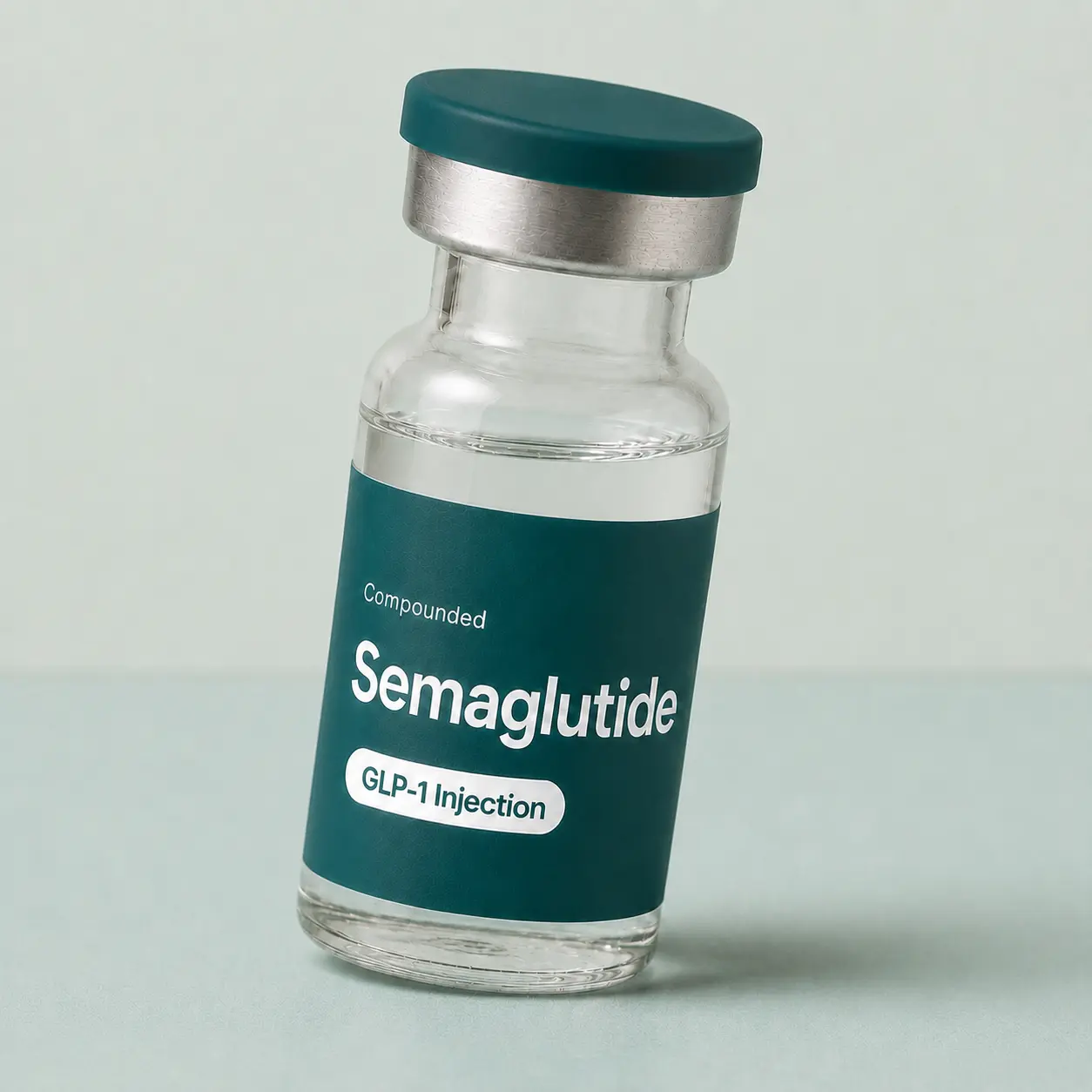
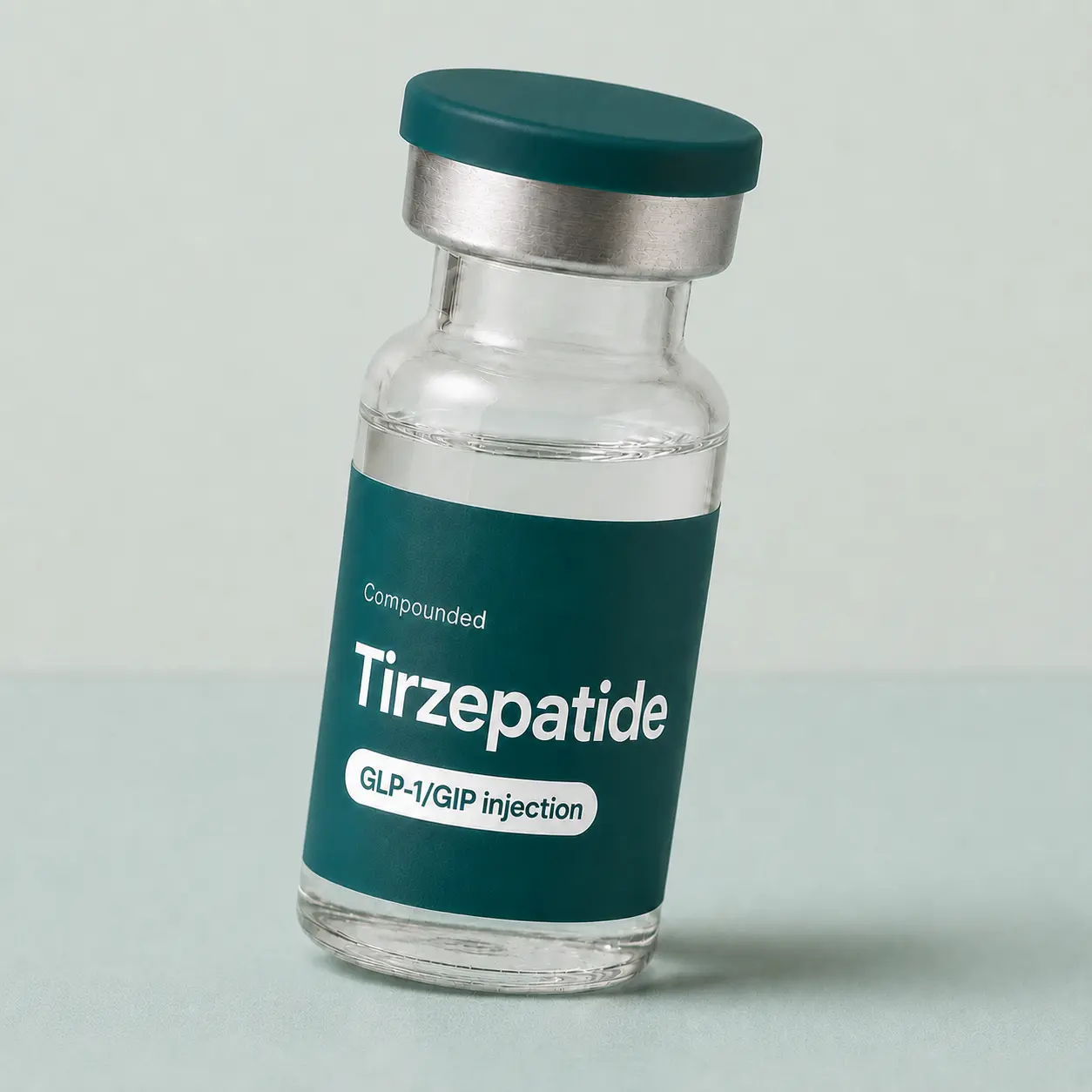
Semaglutide and tirzepatide switch off hunger. They do not switch off the reasons you eat when you aren’t hungry — the bridge between work and rest, the reward at the end of a brutal week, the numbing of a feeling you’d rather not have. Those patterns survive the prescription. For many people, the medication is the first time they can see them clearly.
Our position, stated up front: the medication opens a window. The physiological drive goes quiet, the psychological patterns become visible, and for as long as you’re on the drug, you can rebuild habits without fighting hunger the whole way. The discontinuation trials below show what happens to weight when the drug stops. No trial shows what happens to the patterns. This guide lives in that gap.
What the medication actually switches off
The pharmacology is settled. GLP-1 receptor agonists slow gastric emptying, act on appetite circuits in the hypothalamus and hindbrain, and improve insulin secretion. Tirzepatide adds a second action at the GIP receptor. Food stays in the stomach longer, and the brain’s drive to seek more of it drops. That is the whole mechanism, and it is enough:
- In STEP 1 (Wilding et al., NEJM 2021), 1,961 adults with obesity and without diabetes took semaglutide 2.4 mg weekly or placebo. At week 68, the semaglutide group had lost 14.9% of body weight on average. Placebo: 2.4%.
- In SURMOUNT-1 (Jastreboff et al., NEJM 2022), 2,539 adults took tirzepatide for 72 weeks. Weight loss ran 15.0% at 5 mg, 19.5% at 10 mg, and 20.9% at 15 mg, against 3.1% for placebo.
From the inside, the effect is quieter than those numbers sound. Many people describe the constant background thinking about food — what we’ve written about separately as food noise — going quiet, sometimes before the scale has moved much.
But read what those trials measured. The primary endpoint was percent change in body weight. Not why anyone ate, or when, or what the eating was doing for them emotionally. On that, both trials are silent.
The eating that was never about hunger
The first time you feel sad and notice you aren’t hungry is a strange moment. You wanted food. Your body didn’t. That distinction is the whole game, and most people never get to feel it cleanly until the medication separates the two signals.
Nothing in this section comes from a trial. It is pattern recognition — informed opinion, nothing stronger.
Three patterns come up again and again.
The bridge. You used food to get from one state to another — work to rest, awake to asleep, awkward to comfortable. The transition still has to happen; the fridge has just stopped volunteering. Walking does this better than people expect. So does physically leaving the room where the workday ended.
The reward. You finished a hard week and the celebration was a meal. The problem was never the meal — it’s that the meal was the only item on the list. Substitution works better here than anywhere else, because the point was always to mark the moment, not to eat. The replacement has to be vivid, not virtuous: a sauna, a long shower, a call to the friend who makes you laugh, tickets to something. A salad is not a reward, and your brain knows it.
The numb. You ate to stop feeling. This is the heaviest pattern and the one the medication exposes most, because the anesthetic is gone and nothing has replaced it. Therapy beats every food substitute here. Don’t try to engineer around it with walks and saunas — if eating was doing the work of managing grief, trauma, or an anxiety disorder, the treatment for that thing is treatment for that thing, not an injection aimed at your appetite. We’ll say it plainly, even though we sell the injection: if numbing is most of your eating, a therapist is the right first prescription, and the medication can wait.
One hard line while we’re here: a history of anorexia, bulimia, or binge eating changes the risk calculus of any appetite suppressant. Tell the reviewing clinician before the first dose, not after. This is one of the few places where “talk to your doctor” is the content, not the disclaimer.
What the regain trials showed
Two trials answer the question everyone eventually asks — what happens when I stop?
In STEP 4 (Rubino et al., JAMA 2021), everyone started on semaglutide; at week 20, some participants were switched to placebo. Stopping led to substantial regain, while continuing maintained the loss. SURMOUNT-4 (Aronne et al., JAMA 2024) asked the same question of tirzepatide with a longer lead-in and put numbers on it: after 36 weeks on the drug, those switched to placebo regained about 14% of body weight over the next year, while those who continued lost about 5.5% more.
The flat conclusion: weight loss is maintained by staying on the drug, and discontinuation usually reverses it. Nothing in those regain curves suggests the medication permanently resets appetite. It suppresses the drive while it’s present; when the molecule leaves, the drive comes back.
Two readings follow — one is consensus, one is ours.
The consensus reading: obesity behaves like a chronic condition, and staying on medication long term is legitimate treatment, not failure. The strongest supporting data is SELECT (Lincoff et al., NEJM 2023): in 17,604 adults with overweight or obesity and established cardiovascular disease — none with diabetes — semaglutide 2.4 mg reduced major adverse cardiovascular events by 20% in relative terms (hazard ratio 0.80). Two caveats: that is a relative number, and it comes from a population that already had cardiovascular disease. It does not automatically transfer to a 34-year-old with a BMI of 31 and clean arteries.
Our reading, layered on top: even if you intend to stay on indefinitely, treat the quiet as a construction window. People stop these medications for all kinds of reasons — cost, supply, pregnancy, surgery, preference. STEP 4 and SURMOUNT-4 tell you the hunger will be waiting when you do. Whether the patterns are also waiting depends on what you built while it was quiet. That last sentence is our clinical read, not a trial result — no trial has measured it.
The opposite problem: barely eating
Quieting appetite creates a failure mode the old you never had — eating too little, and too little of what matters.
DXA substudies of the GLP-1 trials show that a meaningful fraction of the weight lost on these drugs is lean mass, not fat. That evidence is real but incomplete: what it means for strength, mobility, or fracture risk at five or ten years has not been characterized. We don’t know. Anyone who tells you otherwise is guessing.
The standard countermeasure is unglamorous: resistance training, plus protein at 1.2–1.6 g per kilogram of body weight per day — the range clinicians commonly target. For an 80 kg person that’s roughly 95–130 g of protein a day, which takes deliberate planning when you’re never hungry. Protein first at every meal you do eat, and treat lifting as part of the prescription.
Dosing matters here too. Standard semaglutide titration starts at 0.25 mg weekly and steps up roughly every 4 weeks — 0.25, 0.5, 1.0, 1.7, 2.4 mg — slower if side effects demand it. In STEP 1, nausea was the most common side effect and clustered during dose escalation. That’s mechanism, not bad luck: the appetite effect and the queasiness are the same lever, slower gastric emptying, pulled harder at each dose step — which is why nausea usually eases once the dose stops climbing.
Two practical consequences:
- Early nausea can impersonate progress. Not eating because you feel sick is not the same as not eating because the noise stopped, and it tells you nothing about your emotional patterns. Wait for a steady dose before you judge how much work is left.
- If nausea is keeping you from getting protein in at all, or you can’t hold fluids down, that’s a same-week conversation with your clinician about slowing the titration — the schedule bends for exactly this. Persistent vomiting is a stop-and-call symptom, not something to push through.
What to do this week
The practical sequence:
- Notice without fixing. For two weeks, when you reach for food without hunger, don’t stop yourself. Just log it.
- Keep a one-line journal. “Sad. Not hungry. Ate anyway.” Feeling, hunger yes or no, ate yes or no. Ten seconds.
- Name the dominant pattern. After two weeks the log usually reads like a diagnosis: mostly bridge, mostly reward, or mostly numb.
- Act on the pattern, not on willpower. Bridge or reward: pick one substitute and run it once this week. Numb: book the therapy consult — the substitutes won’t hold.
- Eat protein on purpose at whatever meals you do eat.
Keep the sourcing straight. The drug effects and the regain numbers are trial evidence. The protein range is standard clinical practice. The five steps above are our opinion — never randomized. If someone runs a decent trial of a better sequence, we’ll swap ours for theirs.
Where Zappy fits
Zappy is cash-pay — no insurance required, FSA/HSA eligible. We prescribe compounded semaglutide and tirzepatide prepared by LegitScript-verified 503A pharmacies in the US. Compounded preparations are not FDA-approved — you should know that before choosing one. A US-licensed clinician reviews every case and owns the titration, including slowing it when nausea says so. If you’re still deciding whether medication fits your situation at all, start with the two-minute quiz.
The trial nobody has run
STEP 4 and SURMOUNT-4 randomized exactly one variable: drug or no drug. They tell us the average person regains without it. They do not tell us whether the regain curve bends for people who spent the window doing the work in this guide — naming patterns, building substitutes, treating the numb with therapy instead of food. As far as the published discontinuation trials go, that is unmeasured.
So the open questions we’re watching: whether structured behavioral treatment layered onto a GLP-1 changes what happens after discontinuation, and whether the lean mass lost on these drugs matters functionally a decade out. Nobody has either answer yet.
The medication buys you the window. The work happens inside it. What no one has measured is how much of the work outlasts the window — and that is the number we most want to see.